🏠 At Home⚡ Quick & Easy📱 Just 2 Devices🔒 Patent Pending📊 Hearing Chart
Your Noise
30dB whisper
60dB talk
85dB caution
120dB painful
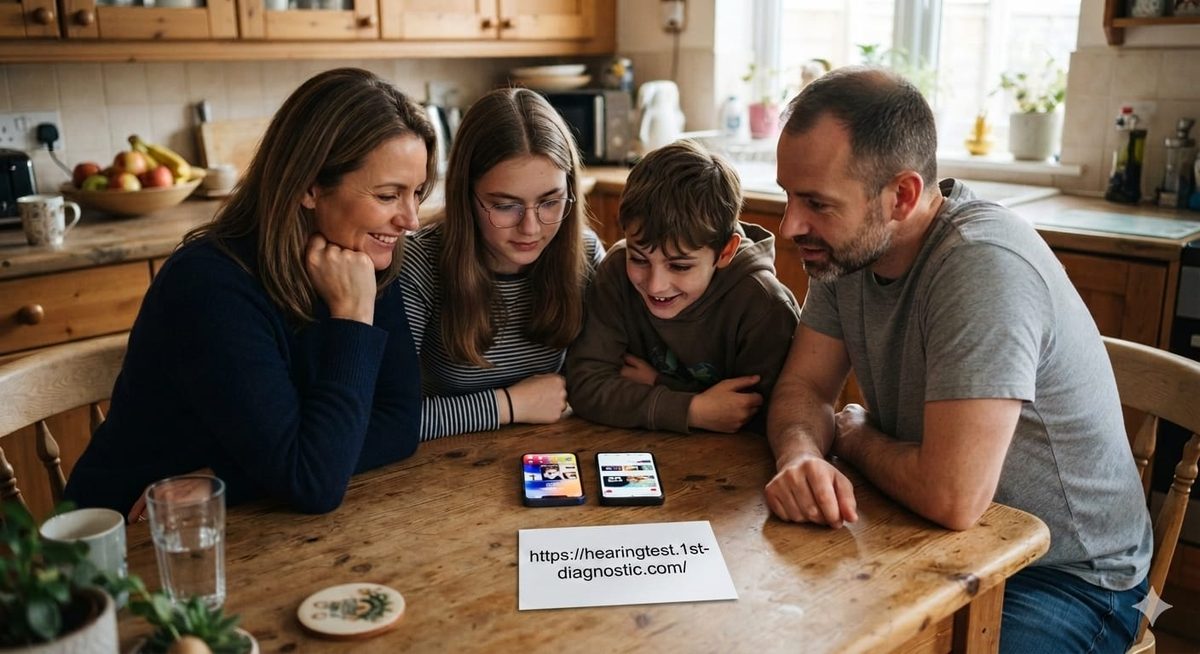
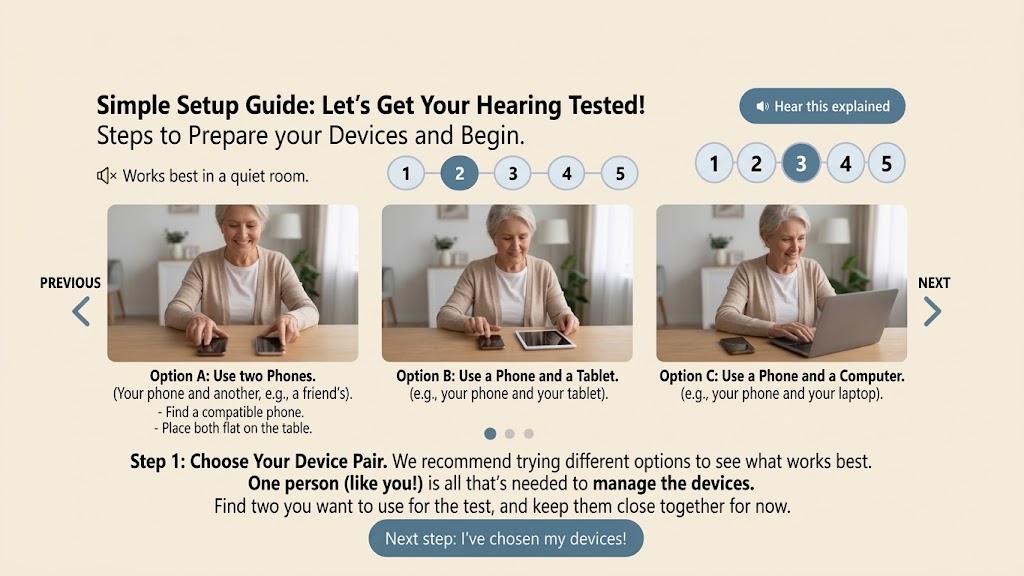
A new, patent-pending way to screen your hearing using two devices you already own — a phone, tablet, laptop, or desktop. No clinic, no appointment — just a quick, simple test that gives you a real, printable hearing chart.
Why hearing health matters
Hearing loss usually develops so gradually that most people don't notice it happening — the brain quietly adapts, filling in gaps and leaning on lip-reading and context, until the loss is already significant. By the time it's obvious in everyday conversation, it's often been building for years. Regular hearing checks catch changes early, while there's the most room to act on them.
This tool screens across the standard frequency range used in clinical hearing tests (250Hz–8000Hz) — the range that covers most speech sounds — using two of your own devices working together instead of a soundproof booth.
👆 Click for Gift Card
SEND YOUR LOVED ONE A GIFT CARD
👆 Click for Gift Card
$1 eachTotal $1 · buy 10, get 1 free
Your gift code(s) — share each one with a different friend or family member:
Each code works once. Tap WhatsApp next to a code to send a ready-made message with a link that starts their test, no payment needed.
6 ways to protect your hearing
General prevention tips — not medical advice. See a doctor or audiologist for any specific concerns.
🔊 Follow the 60/60 rule
With headphones, keep volume at 60% or below, for no more than 60 minutes at a stretch. Take a break, then continue if needed.
🎧 Use hearing protection around loud noise
Concerts, power tools, lawn equipment — simple earplugs make a real difference over a lifetime of exposure.
🤫 Give your ears quiet time
Regular breaks from constant noise (traffic, machinery, headphones) let your ears recover.
🧻 Earwax is normal — don't fight it with cotton swabs
Wax protects your ear canal and usually clears itself. Cotton swabs often push it deeper instead of removing it. If buildup is bothering you or affecting your hearing, a doctor can safely check and clear it.
❤️ Take care of your cardiovascular health
Good blood flow supports the tiny hair cells in your inner ear — the same habits that help your heart tend to help your hearing too.
📅 Don't wait for a problem to check in
Hearing loss is usually gradual and easy to miss day-to-day. Regular hearing checks catch changes early, while there's the most room to act on them.
Not sure where you stand? Find out in a few minutes.
Benefits of testing
🕐 Takes a few minutes
No appointment, no waiting room — done from home with devices you already own.
📈 Track changes over time
Run it periodically and compare reports to spot gradual shifts early.
🎯 Built-in reliability checks
Ambient noise gating and calibration mean a bad reading gets flagged, not silently accepted.
📄 A record you keep
Download a PDF report to bring to a doctor or audiologist, or just keep for your own records.
* This is not a diagnosis, please visit a doctor for health issues.
See it in action first
New to this? Click through this interactive walkthrough — no account, no payment, nothing required.
Quick preview before you start
Before you start
A few details so your results are labeled correctly — used only for this session's report, nothing is sent anywhere.
(optional — compares results to your age group)
Hearing sensitivity naturally shifts with age. Skipping this still gives you your full audiogram — just without that comparison.
Please fill in your name and email, and check the box to continue.
Start your test — $1
One-time payment unlocks this test session. We never see or store your card details.
THIS PHONE IS DEVICE A
STEP 3 OF 5
Which device is this?
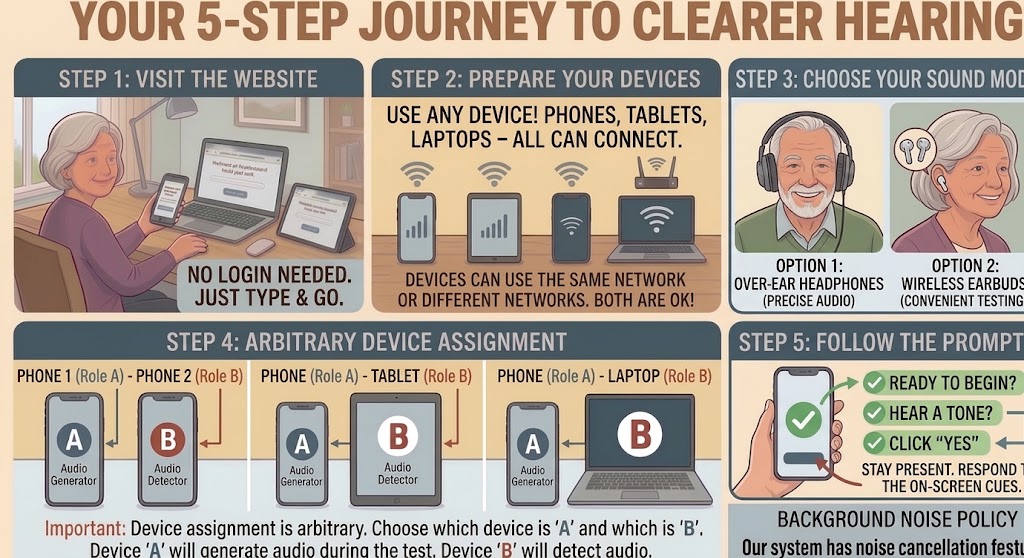
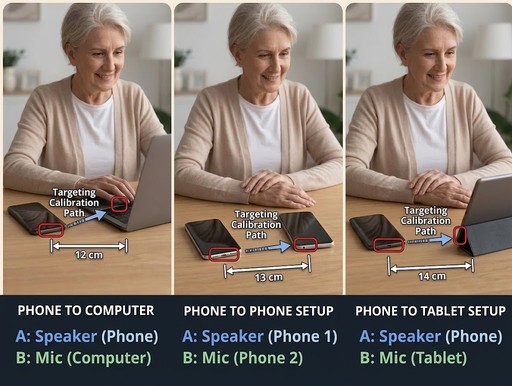
Tap what THIS device is, in the box that matches what it will do — play tones (Device A) or listen with the mic (Device B).
Device A
Plays the sound
Device B
Listens with the mic
Tap a type in both boxes above to continue.
A spectator screen that mirrors two other devices doing the real test — doesn't control anything itself.
Pair your second device
Use Device B (Listen) to scan the QR code or open the link — no typing needed.
Or share this link:
Pairing code:
Connection
Enter Relay URL and Code. Each device — A and B.
Not connected.
Step 1 — Live Monitoring
Device A · Play test tone
Plays a short tone from this device's speaker, so Device B can check it's being heard before the real test starts.
Speaker is usually near the bottom or top edge — varies by device.
Idle — waiting to start.
📱 This is what Device A's screen shows right now
Device B · Checks room noise
Turns on this device's microphone to listen for the tone from Device A before the real test starts.
Mic is usually near the top or bottom edge — varies by device.
Test band level
— dB
Idle — mic not started.
🎙️ This is what Device B's screen shows right now
Step 2 — A→B Calibration Sweep
Both devices
Measure A Tone with B mic
Device A Connected?
Device B Connected?
Waiting — connect both devices first.
* Test measures signal-to-noise — tone vs. silence.
Frequency
Measured level
Noise floor
Signal-to-noise
Step 3 — Hearing Test (Audiogram)
Device A only
Self-paced threshold test
Wired recommended. Bluetooth OK.
Each ear is tested separately.
Before you start — check your earbuds for an "L" and "R" marking.
L bud goes in your left ear.
R bud goes in your right ear.
This applies to wired or Bluetooth earbuds.
CHOOSE:
For each frequency, the tone starts clearly audible and steps down in small increments. Tap "I hear it" to keep stepping down. Tap "I can't hear it" as soon as it disappears — that records your threshold for that frequency and moves to the next one.
Ear: — | Frequency: — | Level: —
Swap ears now. Move the earbud to your other ear (or put in the other earbud), then tap continue.
Ear
Frequency
Raw threshold
Calibration-corrected
These numbers compare your ears and frequencies to each other — they're not official medical measurements. For a true diagnosis, see a doctor or audiologist.
Important: all dB values in this prototype are relative, uncalibrated units (derived from the Web Audio analyser's 0–255 scale), not true clinical dB HL/SPL. They're useful for comparing thresholds across frequencies and for validating the ambient-gating and calibration logic — not for a diagnostic hearing assessment. Turning this into a clinically meaningful test requires a properly calibrated reference (e.g. a calibrated external SPL meter or known-output transducer) tying these relative units to true dB SPL.